 Log in
 Register


The world of spirits or distilled alcoholic beverages often feels confusing for beginners, especially when dealing with terms like bourbon and whisky (or whiskey). Are they two different types of drinks? Why do some bottles feature a bourbon label, while other bottles are written as Scotch whisky, Irish whiskey, to local whisky created by the nation’s children?
The basic difference is actually very simple: all bourbon is whisky, but not all whisky is bourbon.
This article will thoroughly explore the comparison between bourbon and whisky, starting from raw materials, production regulations, flavor profiles, to the best ways for beginners to enjoy them.
Bourbon vs Whisky: What Is the Main Difference?
The main difference between bourbon and whisky lies in their classification and production rules. Whisky is a large umbrella category for alcoholic beverages made from fermented grains and aged in wooden barrels. Meanwhile, bourbon is one specific style of American whiskey that must meet strict legal standards in the United States, including a minimum usage of 51% corn and aging in new charred oak barrels (new oak barrels burned on the inside).
Quick Summary:
Bourbon is part of the large whisky family. Just as a car is a general category, bourbon is a specific type like a sports car. Bourbon is always made in the United States under strict legally bound rules regarding raw material composition and barrel types.
What Is Bourbon?
Bourbon is a legendary style of American whiskey that has a strong cultural identity with the United States, especially the Kentucky region. Although often associated with Kentucky, under U.S. federal legal regulations (Code of Federal Regulations), bourbon can be produced in any U.S. state as long as it meets legality requirements.
Legality and Production Requirements of Bourbon
For a whisky to legally bear the bourbon label on its packaging, producers must comply with the following criteria:
- Production Origin: Produced in the United States.
- Grain Composition (Mash Bill): Uses a minimum of 51% corn.
- Distillation Process: Distilled up to an alcohol content not exceeding 80% Alcohol by Volume (ABV) / 160 proof.
- Barrel Entry: Poured into wooden barrels with a maximum alcohol content of 62.5% ABV / 125 proof.
- Type of Barrel: Must use new charred oak barrels (new oak barrels burned on the inside wall). These barrels must not have been used for any other drinks before.
- No Additives: Must not contain colorings, flavorings, or other added alcohol. Only purified water may be added to adjust bottling strength.
The term straight bourbon refers to bourbon that has gone through an aging process of at least 2 years in new charred oak barrels without being blended with other spirits.
What Is Whisky or Whiskey?
Whisky (or whiskey) is the general category name for alcoholic beverages produced from the fermentation of grain mash, which is then distilled and aged in wooden barrels for a certain period. Commonly used grains include barley, corn, rye, and wheat.
Now, the whisky industry is not only dominated by Western countries. Indonesia also has a global-standard local alcohol producer like Vibe Liqueur & Spirits. The VIBE Whisky product line is proof that high-quality whisky distillation and aging standards can be produced domestically and successfully win various international awards on the world stage.
Spelling: Whisky vs Whiskey
Have you ever noticed the difference in writing the letter “e”? This spelling difference is generally related to geographical traditions and the history of the producing country:
- Whisky (without the letter “e”): Used by countries like Scotland (Scotch), Japan (Japanese whisky), Canada (Canadian whisky), and most producers in Asia and Australia.
- Whiskey (using the letter “e”): Used mainly by producers in the United States (American whiskey) and Ireland (Irish whiskey).
Although the spelling is different, both words fundamentally refer to the same type of drink.
Is Bourbon Included in Whisky?
Yes, bourbon is fully included in the whisky category.
To understand this relationship, imagine the relationship between fruit and apples. An apple is a type of fruit, but not all fruits are apples. The same applies to spirits:
- Bourbon is a specific species.
- Whisky is its genus or category.
All bottles of bourbon on the market are whisky, but bottles of Scotch, Irish whiskey, or VIBE Whisky from Indonesia are not bourbon.
Differences Between Bourbon and Whisky
The following comparison table summarizes the main aspects that distinguish bourbon from whisky styles in general around the world:
| Factor | Bourbon | Whisky / Whiskey (In General) |
| Category | Specific style of American whiskey | Parent/broad category |
| Country of Origin | Exclusively United States | Various countries (Scotland, Ireland, Indonesia, Japan, etc.) |
| Main Grains | Must be minimum 51% Corn | Diverse (Malted barley, Rye, Wheat, or combination) |
| Barrel Type | Must be New Charred Oak Barrel | Highly varied (Used bourbon barrel, Oak cask, Sherry cask) |
| Aging Requirements | No minimum (Except Straight Bourbon min. 2 years) | Varies by country (e.g. Scotch & Irish min. 3 years) |
| Additives / Colorings | Strictly prohibited (No caramel coloring) | Allowed in certain categories/countries |
| Dominant Flavor Profile | Sweet, vanilla, caramel, cinnamon, sweet oak | Highly varied (Smoky, peaty, fruity, malty, or smooth oak) |
What Is Bourbon Made From?
The main raw material of bourbon is a grain combination called a mash bill. The composition of this mash bill is strictly controlled by regulations and secret recipes from each master distiller.
The four main ingredients in bourbon making are:
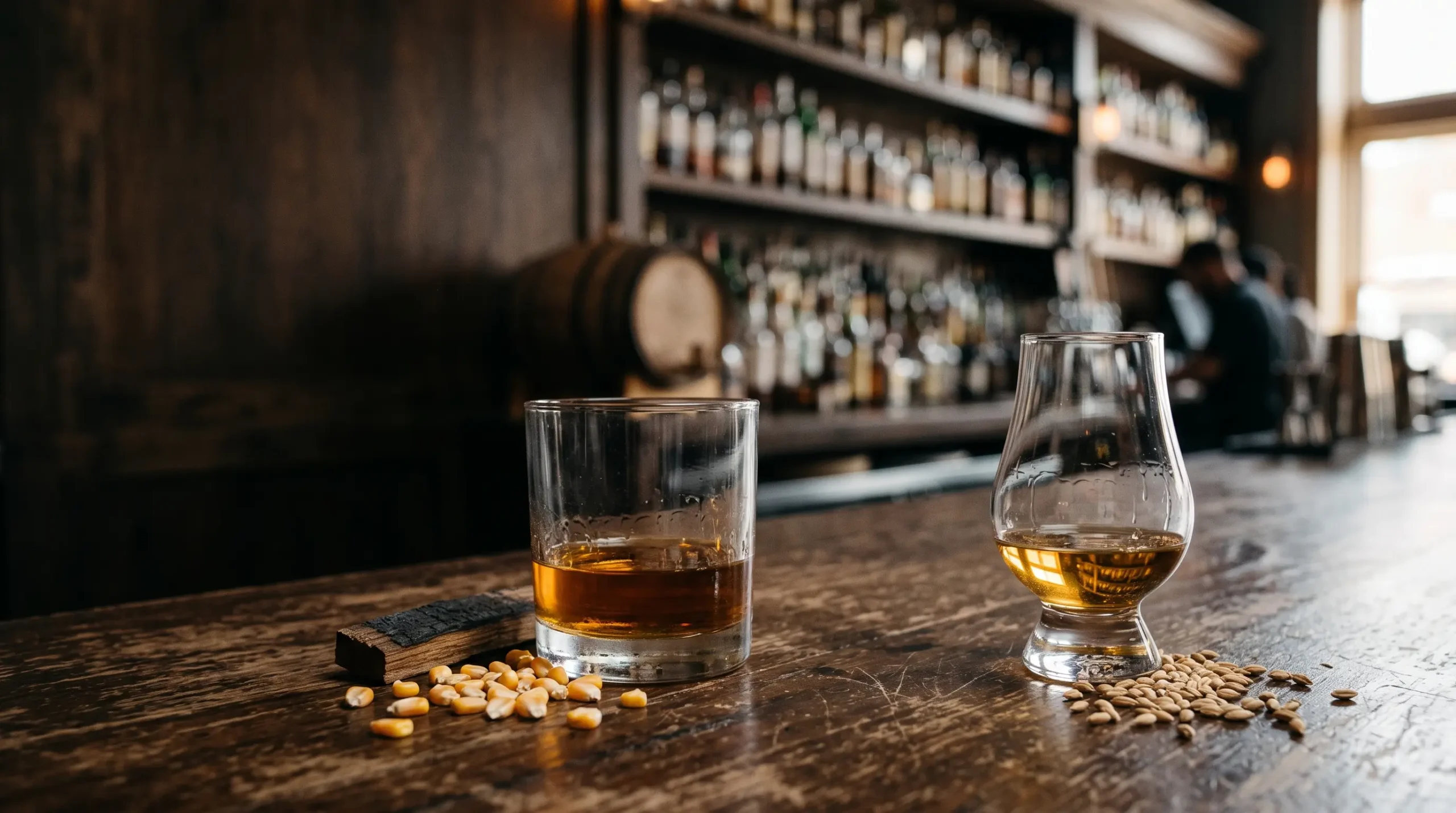
- Corn: Must dominate at least 51% of the overall recipe. Corn provides a distinct natural sweet taste, savory sensation, and a full-bodied texture to bourbon.
- Malted Barley: Usually added around 5% to 15%. This sprouted barley provides natural enzymes (amylase) essential for converting grain starch into soluble sugars during fermentation.
- Rye: Often used as a secondary grain. Rye gives a spicy character, black pepper notes, and a slightly refreshing tart touch.
- Wheat: Used as a substitute for rye in wheated bourbon style. Wheat provides a softer texture, sweeter taste, and a smooth toasted bread character.
Influence of Mash Bill Composition on Flavor
- High-Rye Bourbon: Has high rye content (for example 20–35%), producing a bold, spicier flavor character, and not too sweet.
- Wheated Bourbon: Uses wheat as a secondary grain, producing a very soft profile, strong vanilla aroma, and very approachable for beginners.
What Is Whisky Made From?
Whisky raw materials depend heavily on production style and regulations in its country of origin:
- Scotch Whisky: Specifically for Single Malt Scotch, the raw material is 100% malted barley. For Blended Scotch, a mixture of malted barley with other grains such as corn or wheat is used.
- Irish Whiskey: Uses a combination of malted barley and unmalted barley (in Single Pot Still), giving a texture that feels creamy and silky.
- Indonesian Whisky (Vibe Liqueur & Spirits): Utilizes modern distillation techniques and selected raw materials adapted to the tropical climate, producing a rich and smooth oak-characterized whisky profile.
- Japanese Whisky: Follows Scottish traditions by prioritizing malted barley, but focuses on fermentation precision and delicate aromatic balance.
Differences in Bourbon and Whisky Production Process
Technically, the basic workflow of making bourbon and whisky involves similar steps: preparing the grain mash, fermentation with yeast, distillation, aging in wooden barrels (maturation), and bottling.
However, there are several crucial points in the production process that distinguish bourbon:
- Use of Sour Mash: The majority of bourbon is made using the sour mash technique. A small portion of fermented liquid from a previous batch is put into a new batch to maintain pH stability and flavor profile consistency over time.
- Distillation Limit Height: Bourbon distillation is capped at 80% ABV so as not to strip away the natural flavor character of the original grain ingredients.
- New Barrel Requirement: Other whisky producers like in Scotland or local producers in Asia generally buy used barrels from the bourbon industry or sherry wine industry. Conversely, bourbon producers are required to always use 100% new wooden barrels.
Bourbon vs Whisky: Aging Differences
The aging process (maturation) is the stage where whisky gets most of its color, aroma, and flavor complexity.
Why Are New Charred Oak Barrels Important for Bourbon?
The process of burning the inside wall of oak barrels (charring) changes the chemical structure of the wood. This charcoal layer acts like a natural filter that absorbs harsh compounds while caramelizing the natural sugars in oak.
When bourbon experiences seasonal temperature changes in the United States (hot summers and cold winters), the whisky liquid actively absorbs into and out of the wood pores. This massively extracts vanillin, tannin, and caramel compounds in a relatively faster time compared to maturation in cold climates like Scotland.
Maturation Time Limits
- Bourbon: No minimum aging period for basic bourbon qualification (except Straight Bourbon which requires a minimum of 2 years).
- Scotch & Irish Whiskey: Laws mandate a minimum aging of 3 years in wooden barrels before it can be named whisky.
Important Note: Older age on a bottle label does not always indicate better quality. Flavor preferences are subjective; aging bourbon for too long actually risks making its flavor too bitter due to excessive oak extraction.
Flavor Profile Differences of Bourbon and Whisky
Bourbon Flavor Profile
Due to the majority use of corn and new charred oak barrels, bourbon consistently offers a rich, sweet, and warm flavor profile:
- Main Aromas: Vanilla, sweet caramel, palm sugar, and cinnamon.
- Flavors: Maple syrup, toasted butter, dried fruits (raisins), and a slight touch of pepper spice on the finish.
Whisky Flavor Profile (Non-Bourbon)
The flavor character of other types of whisky has a very wide spectrum depending on its production region:
- Scotch Whisky: Varies starting from light & floral profiles from the Lowlands region, fruity from Speyside, to smoky and peaty (distinct peat smoke aroma) from the Islay region.
- Irish Whiskey: Famous for being very smooth, rich in pear, apple, honey, and cereal notes.
- VIBE Whisky (Indonesia): Presents a balanced oak flavor character, soft vanilla touch, and a warm yet very smooth finish in the throat, making it a favorite choice to drink neat or in cocktail mixes.
- Rye Whiskey: Highlights spicy character, sharp spices, cinnamon, and somewhat dry on the tongue (dry finish).
Bourbon vs Scotch vs Irish Whiskey
To give a more complete picture, here is a comparison between the three largest categories in the whiskey world:
| Feature | Bourbon | Scotch Whisky | Irish Whiskey |
| Country of Origin | United States | Scotland | Ireland |
| Main Ingredients | Min. 51% Corn | Malted Barley / Grains | Barley (Malted & Unmalted) |
| Distillation Method | Generally Column Still | Pot Still (2x distillation) | Generally Pot Still (3x distillation) |
| Barrel Usage | Mandatory New Charred Oak | Mostly used barrels | Mostly used barrels |
| Smoke Character | Almost none | Often peaty/smoky | Very rarely peaty |
| Main Profile | Sweet, vanilla, warm oak | Complex, peat, fruity, malty | Very smooth, fresh, light |
How to Drink Bourbon and Whisky
There is no single rigid rule in enjoying whisky. The choice of the best way to drink completely comes back to individual taste comfort.
- Neat (Without Mixers)
Drunk directly at room temperature in a special glass (like a Glencairn glass or rocks glass). This method is ideal for those who want to evaluate the pure aroma and flavor character of the drink. - With Water (Added a Little Water)
Adding a few drops of pure water can lower alcohol concentration on the surface, loosen chemical bonds of the liquid, and blossom hidden aromas previously covered by alcohol warmth. - On the Rocks (With Ice)
Served over ice cubes. Ice will lower the liquid temperature and provide slow dilution. This way is very popular for beginners because it makes the drink feel fresher and reduces the sharp taste in the throat. - Cocktails
Mixed with other helper ingredients like bitters, sugar, or citrus squeezes. Cocktails are a very good entrance for readers who are just starting to appreciate the flavor profiles of bourbon and whisky.
Bourbon and Whisky Cocktails for Beginners
For beginners who want to enjoy bourbon or whisky in a way that is more palatably friendly, here are several popular cocktail mixes to try:
Bourbon-Based Cocktails
- Old Fashioned: A classic cocktail combining bourbon, a little sugar, Angostura bitters, and orange peel. The sweet flavor of bourbon blends perfectly with citrus aroma.
- Paper Plane: A modern mix combining bourbon, Aperol, Amaro Nonino, and fresh lemon squeeze. Produces a very balanced sweet-and-sour taste.
- Bourbon Sour: A mix of bourbon, lemon juice, and sugar syrup (sometimes added egg white for a soft foam texture).
Other Whisky-Based Cocktails
- Highball: A mix of whisky (like VIBE Whisky or Blended Scotch) with pure soda water and ice cubes. Very refreshing and suitable for tropical climates.
- Manhattan: Uses rye whiskey or bourbon mixed with sweet vermouth and bitters.
- Rob Roy: A variation of Manhattan using Blended Scotch whisky.
How to Choose Bourbon or Whisky
When standing in front of a store shelf or reading a menu at a bar, use the following practical checklist to select the right bottle:
- Determine Flavor Profile: Do you want sweet taste (bourbon), smooth & approachable (VIBE Whisky / Irish), or smoky (Scotch Islay)?
- Observe ABV / Proof Level: Standard bottling is usually at 40% ABV (80 proof). For beginners, avoid starting from cask strength or barrel proof options (ABV above 50%) because the warmth of the alcohol can feel very stinging.
- Consider Usage: Is the bottle intended to be drunk neat or used as a cocktail ingredient?
- Consider Budget & Legitimacy: Choose products that have been officially verified and have an award-winning reputation like VIBE Liqueur & Spirits to guarantee flavor quality and consumption safety.
Find the Right Spirit Choice for You
Understanding the difference between bourbon and whisky is not complicated. Whisky is a large world encompassing various making traditions from Scotland, Ireland, Japan, United States, to local alcohol innovations from Indonesia’s Vibe Liqueur & Spirits. In that large world, bourbon is present as one of the most iconic styles from the United States with production rules tightly bound to the use of corn and new charred oak barrels.
There is no category that is absolutely “better” between the two. Everything comes back to the personal taste preference of each enthusiast.
For those who want to explore the world of quality whisky and alcoholic beverages without being confused to choose, Vibe Liqueur & Spirits is present as a local Indonesian alcohol producer that has won various international awards. VIBE Liqueur & Spirits offers a variety of rich flavor variants with choices of alcohol levels (ABV) that vary, making it very flexible to enjoy neat, on the rocks, or used as a base for various favorite cocktail recipes.
Want to know more about hit hangouts, drink mixes, and lifestyle inspiration? Visit wekendvibe to get complete information regarding venue recommendations, practical cocktail recipe guides, as well as various unique and interesting facts about the world of spirits!